Sex On the Beach: Hot Times on Fire Island
Pride, Beauty, and the Beach
A striking contradiction of attitudes toward human sexuality in western pornography lies in the portrayal of anything outside heterosexual behaviour. Ever since A Free Ride (circa 1915) depicted a threesome between a man and two women, the western preference for female bisexuality and/or lesbianism shines through in almost every mainstream porno. Moreover, it’s becoming a staple of mainstream television where sitcoms, medical dramas, and superhero shows will feature a lesbian couple far more than they will a loving gay male couple. Among Americans, there’s a higher degree of public approval for a sexual relationship between two women.
If the dynamic of the threesome is reversed, with two men and a woman, then the two men will likely never touch each other in any way other than a high-five. At the least, the two men are rarely intimate with each other as both are there to enjoy the company of the woman more than they are the company of each other.
Yet the audience for mainstream pornography expects bisexuality from their female performers. In the 21st Century, a common format for a pornographic video is that it should have little-to-no plot and get straight into the action. There may be a five to ten minute set up, but it’s quickly thrown aside as it’s getting in the way of the fucking. But in the 1980s and 1990s, when feature length adult films were common, your standard porno would feature at least one scene of three or more participants and at least one lesbian scene.
But what about the other side of the homosexual coin? Where’s all that guy on guy action?
The largest consumer of pornography tends to be the heterosexual male, though the numbers have changed over the decades. If the Internet helped promote anything in adult video production it’s that it opened doors to differing tastes like “couples friendly” work that caters toward heterosexual women looking for something more romantic than a five minute set up followed by grunting and moaning. Yet the standard consumer remains, and the average heterosexual male would prefer to watch a surgery than view a video of two guys having sex. Throw in an artistic style, with exciting sex between these two men, and you’ve lost your heterosexual male completely.
You can blame Western Christianity for the “sin” of homosexuality. During global periods of antiquity, homosexual relationships were commonly depicted in the art, stories, and history of multiple societies. Greek and Roman art run rife with depictions of gay sex. Within the Japanese samurai, homosexuality was commonplace. Sexual activity among men wasn’t scandalous or sacrilegious until religion made it so. Before that, it was simply a fact.
And when it comes to adult movies, the gay market is out there, and it always has been. Like all genres, fetishes, and orientations that pornography caters to, the quality of gay porn varied from trashy exploitation to art house, with much of it trending towards the former. It was this lack of quality that inspired one man to make his own films, with style, beauty, and cinematography too often missing in gay porn.
At the end of the 1960s, with the 70s rising above the horizon, Wakefield Poole and his friend went to see a porno called Highway Hustler. Poole hated the film, calling a “black socks” movie, where all the performers fucked on a bed wearing nothing but black socks. He was convinced he could make a better movie, where gay sex could be celebrated and depicted as something loving and beautiful. Sure, he’d never made a movie before but why let that get in the way? He’d worked in television, so he wasn’t unfamiliar with cameras, shooting, and planning a production.
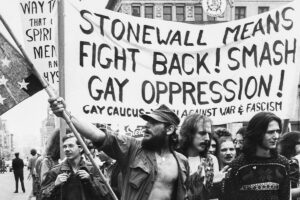
A public celebration of gay sex was something new to the United States, barely emerging from the shroud of homophobia draping the nation, a dark shadow hanging over the country today. Gay pride threw back its head and screamed its birth cry a year before, in 1969 at a dive bar in the Greenwich Village neighbourhood of Manhattan in New York City. The Stonewall Inn was the only bar in New York City where gay men could dance together. Like many other bars in the area, it was owned by the Italian Mafia, the Genovese family. On the surface, it wasn’t anything special, just a gay bar where a few lesbians and transvestites would hang out.
That changed in the early morning hours of June 28, 1969 when the New York Police Department conducted a raid on the Stonewall Inn. The police raided gay bars all the time, indeed it was customary that those on staff would be tipped off to the raid. It made things move along in a smoother fashion.
The reasoning was often specious, if not utterly fabricated, coming down to allegations of vice like prostitution and drugs. But that morning, most of the Stonewall’s customer base knew the score. While homosexuality wasn’t exactly outlawed in New York City, it was functionally illegal to be gay.
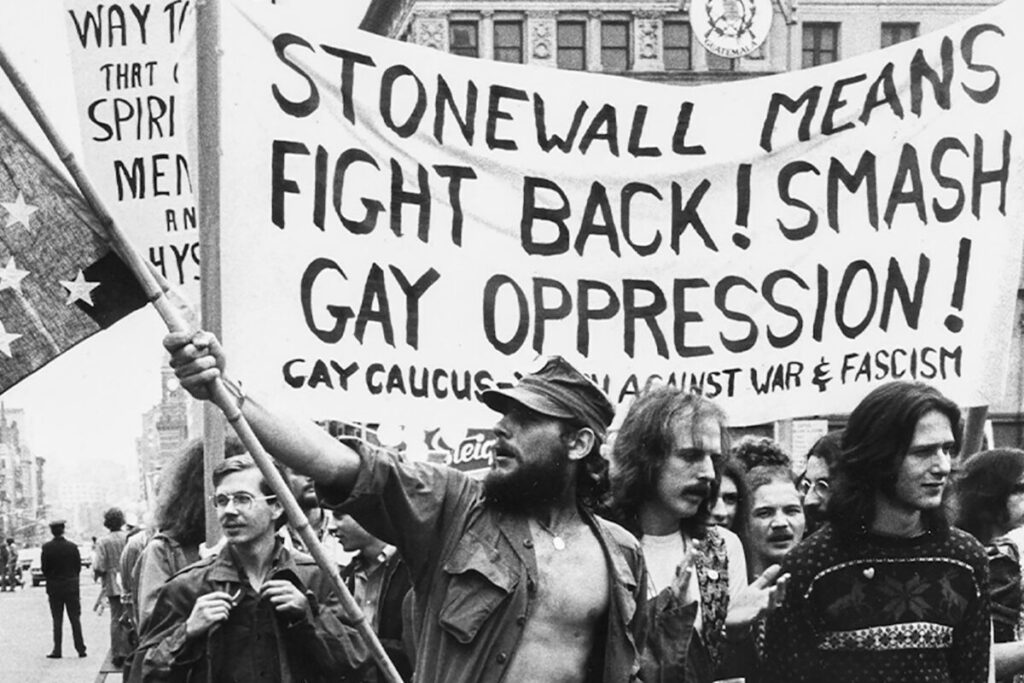
The problem with this raid was that it didn’t go according to the usual script, the common plan the police had for these affairs. After the cops descended on the bar, a crowd gathered outside. Rumours circulated among the assembled that the police were beating patrons inside the bar. Such a rumour was perfectly inline with the day-to-day experience of the Village’s GLBTQ community who were well-acquainted with the rampant homophobia openly displayed by the NYPD. When the crowd saw a policeman use his baton on Stormé DeLarverie, a well known butch lesbian who was handcuffed and defenceless, the crowd erupted. The Stonewall Riot began with the police assaulting someone unarmed and in handcuffs, a disturbing trend extant in modern American policing today.
From the riot and the civil unrest that followed, the homosexual community planted their flag in the ground and drew their line. It was okay to be gay and fuck you if you didn’t like it. The Pride movement began as a simple celebration of the anniversary of the Stonewall Riots, an Independence Day for homosexuals everywhere. While the creation, distribution, and sale of homoerotic films remained illegal for some time afterwards, gay filmmakers stood upon the movement and dared the authorities to make it a criminal matter.
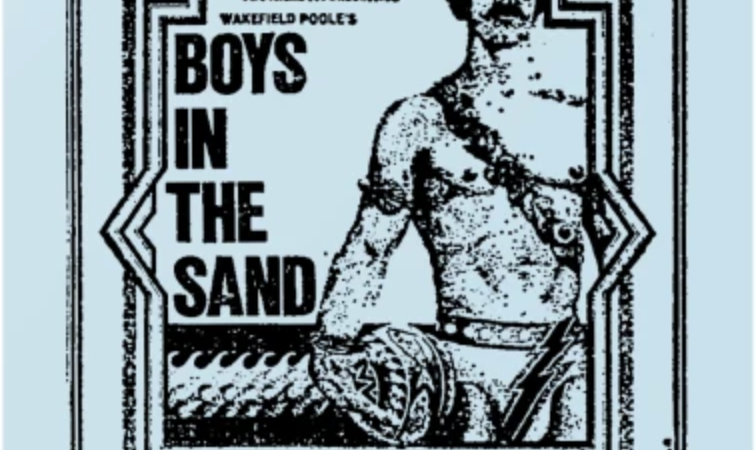
It was during this pivotal moment that Wakefield Poole decided to make the porn movie he wanted to see. Rounding up friends and acquaintances, including his own lover, along with $8,000 in funding; he created what is undoubtedly the first classic in American hardcore gay pornography: the 1971 masterpiece Boys in the Sand.
Boys in the Sand
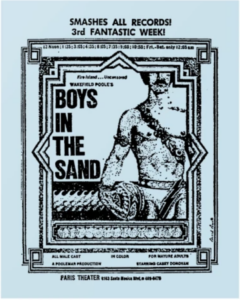
Before looking at the story within Boys in the Sand, we need to understand the setting. Because the movie is more than a few guys boning down on the beach or getting it on by the pool. The entire movie was shot on Fire Island, a long and narrow stretch of beach southeast of Long Island, New York. A haven for an affluent gay population, Fire Island is a gorgeous stretch of land steeped in sexuality and celebrated in song and prose by the gay community. The Village People sang about it in 1977. Patricia Nell Warren wrote about it in The Front Runner in 1974, the first book of gay fiction to hit the New York Times Best Seller list. As you take in the sex scenes of Boys in the Sand, you can’t help but notice that the movie is also a love letter to Fire Island.
Wakefield Poole wanted to evoke the beauty of the location, and staged his scenes accordingly. Only one of the three scenes in the movie takes place inside, and even then, the interior location is sumptuous and beautifully designed. Poole saw no reason to portray gay sex as something dirty to be hidden away. His performers are fucking each other outside, warmed by the sun and cooled by the breezes washing over the island. There are four sexual performers throughout the film, but Fire Island itself plays an uncredited fifth character, as beautiful and sensual as the men in the cast.
Bayside
With our first scene we’re introduced to a handsome young man, Peter Fisk, who was Wakefield Poole’s lover at the time. He’s walking through the sands and out toward the water. We follow him through the trails down to the beach, early morning sun dappling the sands with light. Poole shot this opening scene around six o’clock in the morning because the light was perfect, shining through the trees and bushes, playing on the beach and the waves off the cost of Fire Island. Poole shot this part early in the morning not only because of the light, but because people across the bay would be able to see Peter as he disrobes and lies naked on a towel. The observant viewer may catch the glimpse of a rainbow patch on his jeans as he removes them and tosses them aside.
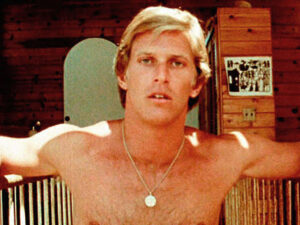
At its essence, Boys in the Sand is a fantasy movie, and we’re greeted to our first taste of fantasy as our leading man, Casey Donovan, emerges from the water, running naked through the waves. Casey Donovan is an advertisement for a modern depiction of white male homosexuality. Young, virile, blonde, and well-built. A statuesque man full of masculinity, yet one who shows no interest in women. The thing that terrified homophobic men across the country. To say he was an advertisement isn’t far off the mark as Casey Donovan, aka John Calvin Culver, was a professional model represented by the prestigious Wilhelmina agency. His beauty led him into a life of being one of the highest priced escorts in New York City.
While some may scoff at his life as an escort or sex worker, there’s no denying Casey’s other talents. He was an excellent model to be sure, but the scope of his brilliance extended into acting. He appeared in Broadway productions, with the legendary Ingrid Bergman praising him for possessing “the same kind and as much charisma as Robert Redford.” Along with acting he tried his hand as a producer, but remained unsuccessful in that realm. He turned his keen mind to writing in 1982, publishing a regular column in the gay-focused Stallion magazine. In this column, “Ask Casey,” he offered advice, thoughts, and observations on homosexual life and love.
It was Boys in the Sand that cemented him as a legend in homoerotica, for reasons we will soon explore.
Casey and Peter begin their tryst on the beach, with the waves lapping the sands in the background as Peter takes Casey in his mouth. He runs his hand up and down Casey’s body, almost as an act of worship. Casey is wearing a ring at the base of his cock, something a tad provocative for 1971. Peter gets things started, but they take themselves behind the bushes for the rest of the scene.
This scene, like all of the movie, was shot with a handheld camera. According to Poole, he wasn’t looking to set up shots when it came to sex. He favoured a more realistic way of taking in the action. This style, akin to cinema verite, led to natural performances among performers who were genuinely into the idea of fucking each other. Poole offered little direction, seeking spontaneity instead, a scene where two people are enjoying each other in a way that’s not “part of the job.” He said that shooting pornography necessarily turns you into a voyeur, and it’s habit forming. From the romantic kissing to the hardcore down-and-dirty, this movie stands apart from much of the industry as a couples film, where the sex is hot, but fun and playful.
As Casey takes the lead, he places a leather ring around Peter’s cock, a symbolic gift. They continue exploring each other with Casey eventually topping Peter, riding him from behind until he sits astride his chest, masturbating to orgasm. He helps Peter find his release, and they kiss as they enjoy the afterglow.
Peter removes the leather cock-ring Casey gave him earlier and places it on Casey’s wrist. With a final kiss, he runs away, into the ocean, and disappears in a similar manner to Casey’s earlier appearance. Casey is left on the island, alone on the beach. This bit of fantasy is never explained, it’s up to the viewer to fill in their own story. Casey picks up Peter’s abandoned clothes and gets dressed, a comical scene at that because Peter was noticeably taller. He walks away down the beach, and the scene ends.
Poolside
Fire Island is more than beaches. There’s are thriving, and expensive, communiities on the island and we get our first taste of that with the second scene, titled Poolside. Wakefield Poole wanted to show what the commercial side of Fire Island is like, and we open the scene with Casey sitting on a fence near the docks. Underneath his arm is a copy of Gay newspaper. At the time, the two major publications for the homosexual community were Gay and The Advocate. However, The Advocate was a west coast publication while Gay newspaper was an east coast thing.

Poole zooms in on the paper’s headline, which calls out the largest bar raids somewhere beginning with an M. We can’t see where, because the headline is cut off by Casey’s arm. But the archives of the New York Times from July 19, 1971 reveal an article detailing how a joint federal and local law enforcement strike force closed down nine after-hours bars in Manhattan the day before, specifically in Greenwich Village. While the NYT says that the customers weren’t the target of the raids, it describes how they were kept in nine small rooms until they were released the following morning. Agents of the Bureau of Alcohol, Tobacco, and Firearms, then a division of the Internal Revenue Service, impounded the booze, equipment, cash and, for some reason, the jukeboxes from these bars.
These pubs were also owned and operated by the Mafia, as were almost all the gay bars in New York City. The article states that these places had reputations to be gay bars, but that “…the people who emerged from the New Showplace and Tenth of Always yesterday morning appeared to include all sorts — young people, married couples, transvestites, lesbians and a few who appeared to be out-of‐towners in business suits.” The customers in many of the bars, thinking they were going to be arrested, dropped their illegal materials; leading to the collection of marijuana, pills, liquids, and a single automatic pistol.
This scene starts at the docks, where the ferry comes in. Many of the residents lock up small wagons near the docks so they have something to help them haul things home after a day in New York City. Casey wanders the docks, looking out to the water for something, or someone, but eventually he goes home. We see that he seems to be doing well on the island, as he’s got a lovely house, a pool, and a large dog. But he’s alone, and you can feel that solitude watching him walk around, almost meandering and looking for something to do, or somewhere to go. During this opening segment, we see no one else, only Casey and his dog.
Loneliness washes in and out of this movie as every single scene starts with a single character, alone, and wishing for company. Peter arrived at the beach on his own and waited for Casey. When they finished having sex, Peter runs out to sea, leaving Casey alone. Now we find Casey waiting, staring into the distance. Poole captured stunning images of the island throughout this second act, with gorgeous sunsets and bright/dark contrasting scenes of the walking paths.
Back at his pool he strips off his clothes and reads through the paper, when he happens upon something that interests him. Running inside, he writes a quick letter, but we see nothing about who it’s to, or its purpose. Soon he’s dressed again and dropping it in a post box.
Time passes, represented by the burning pages of a calendar, and Casey spends his time swimming and living a lovely, but solitary life. The special effect of ghostly pages, burning and passing through the scene was achieved on camera, something that Poole was proud of because, after all, this was his first film.
Finally, one day he picks up his mail. As he leaves the post office, an actual post office on Fire Island at that time, we see another person. It’s a boy walking down the same path in the opposite direction with a kite hanging over his back. It’s a chance occurrence but, intentional or not, his presence comes to represent the end of Casey’s loneliness. Casey passes him, and, at the intersection of two paths, he runs off.
Back home he rushes by the swimming pool, stopping long enough to place a small package at the edge. He disrobes, sits by the poolside and opens the box. Inside is a large, circular tablet in a clear box. He tosses the tablet in the pool and it begins to bubble, like Alka Seltzer. The bubbles grow into a torrent until a naked man emerges from beneath the surface.
Wakefield himself talks about how the audience in a theatre would grow quiet during this scene, wondering what was happening. And they’d laugh when he burst through the water, not as a derisive thing, but because it’s genuinely funny.
That audience in a cinema deserves some discussion as this was a time when you could find places screening pornography as a subject of artistic interest. It was a highlight of the Golden Age of Pornography in that, while porn wasn’t new, it was certainly nouveau and captivating. Audiences were curious about how one could tell a story with the inclusion of hardcore sex and this was a specific feature of the Golden Age films: a story. As Deep Throat has a story, so too does Boys in the Sand, and all the other classics of this period. To use the old joke about reading Playboy magazine for the articles, audiences were interested in the new pornography because of the story. Sure, they were excited about seeing sex on the screen, but many of them wanted a journey from a beginning to an end. The sex was part of the story, part of journey and the friends made along the way.
The story didn’t have to make perfect sense because, as we’ve seen, there are magical elements to this film. People appear out of nowhere, standing in the ocean. Then they run into the ocean and vanish. And one can order a tablet through the post that effervesces into a hot man of Italian descent named Danny DiCioccio.
Danny worked construction with a side gig in softcore porn, shooting scenes with Colt, a studio that got its start in New York City in 1967. At the time, Colt wasn’t doing hardcore, opting to use a style of photography that was closer to modelling. Since the performers weren’t having sex, at least not camera, they’d frequently change positions to add variety to the photos. Poole says he had to remind Danny that this was a hardcore shoot, and he could take his time and roll with the flow.
That’s one of the few times Poole offered actual direction to the sex scenes. Throughout his career, his actors would have the sexual experience they desired, in a way that felt natural to them. Poole’s role was documentarian, he was there to shoot the action while maintaining some distance and letting things happen.
Once you know that, this movie becomes even more sexually charged as these are actors that want to fuck each other. You can see that in this second scene as there’s a touch of hesitation at the outside, until the action becomes heated and breathless. They roll around by the pool, kissing and embracing, giving and taking, until each has mounted the other. The release that Casey sought throughout his loneliness makes this scene heavier than the one before. The soft, gentle explorations of each other are tossed aside to get right to the point.
But the heated sex concludes with the lovers falling back into the pool, frolicking in the water and lounging naked together in massive, inflatable pool float. They emerge later, and dry each other off in a loving way. A quick cut to black, and they leave the house, holding each other and talking, like any other couple. They wander down the path into the last touch of fantasy for this scene.
As they walk down the boardwalk to the town, they pass the post office, where this act began. This time, there’s another man sitting on the fence outside, looking out to the water. In reality, this is Edward Parente, a graphic designer and artist who created the original promotional material for the movie and the opening title card. They smile as they pass him, and he watches them go by. When the camera pans back to the man on the fence, a copy of Gay newspaper has appeared underneath his arm, just as Casey was holding it. The man, surprised by the appearance of the paper, looks it over, and tucks it back under his elbow as he walks the opposite way down the path. Perhaps it’s his turn to find happiness?
Inside
While Boys in the Sand was Wakefield Poole’s directorial debut, he wasn’t a stranger to show business. Before picking up a camera, he soared across the stage as a professional ballet dancer and choreographer. In 1957, he joined the Ballet Russe de Monte Carlo before going on to work in television and on Broadway productions. Yet his first movie is a masterwork of breaking stereotypes. These men are not your 1970s gay comic relief, personified throughout the decade by the great Paul Lynde. The movie is a paean to homosexual eroticism and relationships, driven by the belief that gay sex is beautiful and should be celebrated. It became a pivotal film for another reason, and that reason is found in the third and final act: Inside.
Inside features Casey Donovan and Tommy Moore. Tommy was a bartender at a pub in Cherry Grove, a small hamlet on Fire Island. The Grove, as it’s known on the island, has a reputation as one of the most accepting communities and resorts for people in the GLBTQ population. Casey and Tommy knew each other and Casey wanted Wakefield to include Tommy as a performer. It was a courageous move by Casey, and a groundbreaking decision for Poole, as it meant that Tommy was likely the first African American man in mainstream gay porn.
The scene opens with Casey lying naked in bed, looking out the window. We cut to Tommy wandering around outside, down on the boardwalk. He wears a telephone lineman’s belt, borrowed from an actual lineman as the telephone company office sat behind the house that was the location for this act. Poole mentions that the house was loaned to them by a resident of the island, and he let them have the house for the day.
Casey is alone, again, though we have no idea why. He’s listless, lying awake on the bed and staring through the window at nothing. He’s unaware of Tommy as he gets out of bed and goes for a shower. After he’s done, he opens a large door-like window at the top of the house, standing nude before it and looking out. At this point, he sees Tommy walking down the boardwalk, inspecting the phone lines. The two make eye contact as Casey exposes himself to him, but Tommy turns and walks away from the house.
A look of sadness crosses Casey’s face, and he turns away from the window and goes back inside. But as he reaches the edge of the balcony he sees Tommy down below, in the house, sprawled on a couch wearing only his lineman’s belt. With Inside, we dive headlong into the fantastical elements of this movie. Reality and fantasy blur together, cutting between each other scene by scene until it’s hard to know what’s happening. Tommy appears in different places around the house, and Casey is there with him, going down on him and using the hookups on the belt to pull Tommy into his mouth.
Suddenly we’re back to Casey on the bed by himself. Tommy stands in a window, his lithe body framed within, and he disappears. Poole uses quickly panning shots of the coloured glass and windows within the house to snap between reality and fantasy and, for now, we’re back to reality as Casey finds himself alone on the bed. Yet he’s as horny as ever, evidenced by the fact that he’s lubing up a large, black dildo.
Boys in the Sand wasn’t without controversy, but the homosexual erotica was only one side of it. The movie takes no issues with race. Casey, a white man, is having passionate, joyful sex with Tommy, a Black man. Nothing is said about it, and it’s not put forth in any special way. These guys are going to bang, and they don’t care what colour they are. This flips around and comes back to the dildo that Casey mounts a few seconds later. It’s a black dildo, a portrayal of Black manhood penetrating a white man. And we can tell that the white man enjoys it. Dildos had been used in porn before, but this was something different at the time.
Beyond race, the scene continues with Casey using a popper. It’s not hidden, something you catch only if you’re looking for it. It’s right there, it’s part of the scene as he inhales amyl nitrate on camera. Amyl nitrate, the active ingredient in a popper, is ostensibly used for chest pain. Side effects include blood vessel dilation leading to mild feelings of euphoria accompanied by muscular relaxation, particularly within the gag reflex and the sphincter. Moreover, many users report an intense desire to fuck, or be fucked, while using the drug. Needless to say, the drug was popular among gay men and made its way into mainstream pornography.
But whether the euphoria is sexually related or drug induced, Casey’s visions of Tommy return as they culminate the scene in riding each other to orgasm. Tommy’s dark skin contrasts with Casey’s tanned body, adding an extra visual flair to the scene. The image blurs and we return to Casey riding the dildo until he reaches orgasm, we’re back to reality once more.
Casey cleans up and wanders naked out of the bedroom, checking out the house as if to see if it was all a dream. With no sign of Tommy he walks downstairs for a final look around. The camera spins past the furniture and the decor of the ground floor before landing on the door, where Tommy stands ready to come inside. In this case, dreams do come true.
As a pornographic film, Boys in the Sand set the groundwork for the gay porn scene that was to follow. There would be better movies, but this one was the first – at least it was the first in the mainstream. Looking beyond the sex, you’ll find this movie is almost a travelogue. It’s a trip to Fire Island, and a journey back to 1971 when there was no AIDS, sex was free, and the societal mores finally began to shift. It wasn’t easy being gay then, and it certainly isn’t now either. To see a celebration of gay love, homosexual erotica, in such an artistic form; it’s as illuminating now as it was then.
If we go further, Boys in the Sand is, in every way, an independent film. The director wrote the film. The actors were friends of the director and they brought their friends into the production. It’s low budget, but high concept. There’s no big studio and everything is shot on location. The film’s staff was tiny, with Wakefield Poole doing the majority of post-production work himself. The movie ran in playhouses, art houses, and movie halls.
The history of the gay rights movement has so many dark places, where bigotry and fear run rampant. Boys dives into that darkness naked, screaming, and blazing with light to cast aside the shadows. Yes, it’s porn.
And it’s superb.